
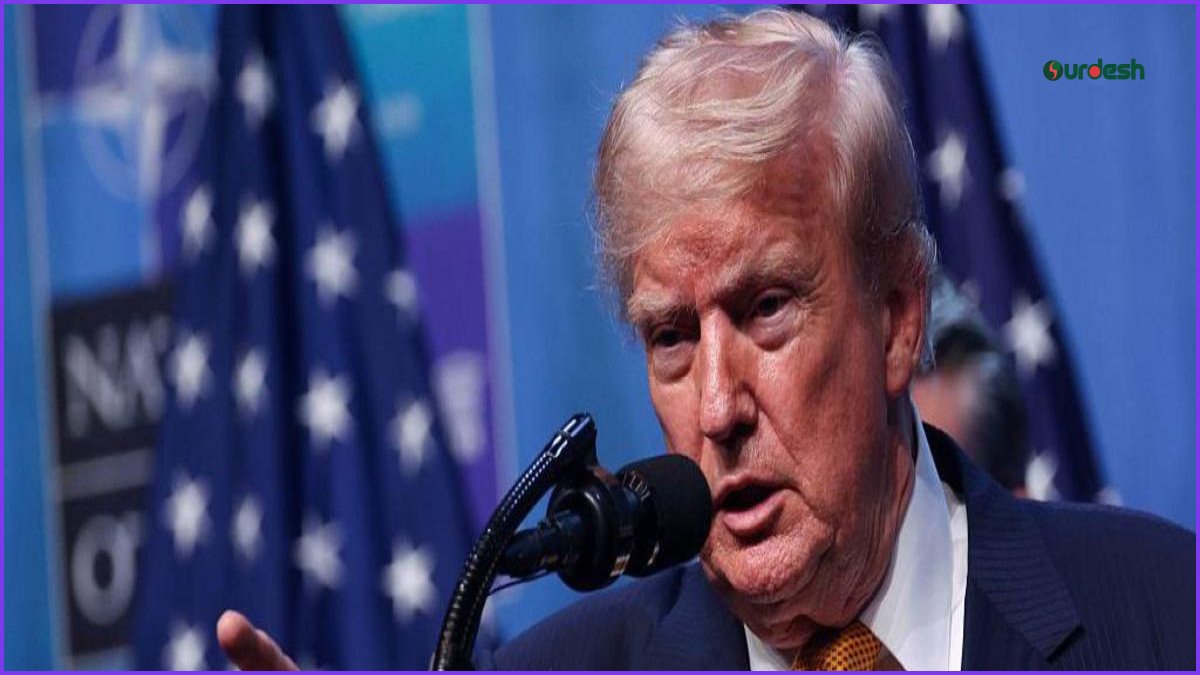
President Donald Trump has announced that the United States is reinstating a naval blockade of Iranian ports and will impose a 20% charge on all cargo shipped through the Strait of Hormuz. In a social media post, Trump stated that the blockade is intended to prevent "Iran's ships or customers" from entering or leaving the vital oil shipping route. However, he emphasized that "all other countries will have fair and open use of the Strait," insisting that the waterway "will remain OPEN, with or without Iran."
Declaring the United States as "THE GUARDIAN OF THE HORMUZ STRAIT," Trump stated that the U.S. would be reimbursed at a rate of 20% on all cargo to cover the costs of providing safety and security in the region. He added that the process and formation for this initiative would begin immediately, asserting, "We are taking over the strait."
This announcement follows a significant escalation in regional hostilities. On Monday, the U.S. reported carrying out strikes against military targets in Iran, specifically hitting air defense systems, coastal radars, and missile and drone sites. In response, Iran claimed it struck U.S. military bases in Kuwait, Jordan, and Bahrain, as well as radar installations in Oman. Prior to Trump's announcement, Iran's top military headquarters warned that it would not allow the U.S. to interfere in the management of the waterway. Ebrahim Zolfaghari, a spokesperson for Khatam al-Anbiya, stated that U.S. "repeated adventurism and malicious actions" had endangered regional security and international trade. He warned that any cooperation with the U.S. would be considered an act of "war" against Iran's sovereignty and cautioned that if the conflict spreads, "the flames of war will engulf all the countries of the region."
The International Maritime Organization (IMO), the UN agency that regulates global shipping, has voiced strong opposition to the plan. A spokesperson for the IMO stated that the agency "stands firmly against charging fees for passage through straits used for international navigation," adding that there is no legal basis for introducing mandatory tolls simply to transit through a strait. Meanwhile, Tehran has not yet provided an official comment on the specific fee announcement, though it has previously labeled the U.S. presence as a "pirate army" and vowed to deal with any disturbances.
The legal and geographical context of the strait is complex. Under United Nations rules, countries may exercise control over territorial seas up to 12 nautical miles from their coastline. At its narrowest point, the shipping lanes of the Strait of Hormuz lie entirely within the territorial waters of Iran and Oman. Historically, the strait has been a critical artery, with approximately 25% of the world's oil and 20% of global liquefied natural gas passing through it. Traffic in the region effectively ceased after the U.S. and Israel launched strikes against Iran on February 28, leading to retaliatory missile and drone attacks by Tehran. The Islamic Revolutionary Guards Corps (IRGC) previously fired on commercial ships and seized two vessels, causing a sharp drop in traffic and a rise in oil prices. While the U.S. had previously imposed a naval blockade in April, it was lifted in June as part of a memorandum of understanding to end the conflict.
Domestically, the move could prove politically sensitive. While the administration may be attempting to force new negotiations or increase international involvement, the announcement has drawn scrutiny. Some Republican lawmakers have previously questioned the strategic gains of the ceasefire and its extensions. Furthermore, with oil prices showing signs of rising again, the administration faces potential backlash from constituents concerned about costs. As of now, ship tracking website MarineTraffic reports that while a small number of vessels are moving through the area, traffic remains restricted.
Some lawmakers – including fellow Republicans – had openly questioned what the US gained from the ceasefire, its extension and further negotiations.
Many Americans are also likely to wonder why – despite repeated promises to the contrary – oil prices are inching up again. Trump is not on the ballot for the upcoming midterm elections, but other Republicans are and will be hearing from constituents concerned about prices.